Don't leave a trace: Private Browsing in Firefox
Today, a major feature was added to the pre-release versions of Firefox 3.1, called Private Browsing. I've been working for quite some time on this, so I thought it may be a good time to write about what this feature is and how to use it.
As you may know, while you browse the web, your browser usually records a lot of data which will later be used to improve your browsing experience. For example, it records a history of all the web pages you have visited, so that later if you need help remembering a site you visited a while back, it can assist you in finding that site. Now, that is great, but there is a downside: those data can be used to trace your online activities. For example, if your coworker sits at your computer, she can view all of your browsing history, which may not be what you want.
Suppose you're doing something online, and you don't want your coworkers know about it. An example scenario would be looking for a new employer while at work! One option would be to do your work, and then clear the data that Firefox has stored for you, such as history, cookies, cache, .... But the problem is that this action will also remove the parts of your online activities data which you don't want to hide, so the history that Firefox records can no longer be used to find a web site you had visited a month before. Private Browsing will help you here.
Private Browsing aims to help you make sure that your web browsing activities don't leave any trace on your own computer. It is very important to note that Private Browsing is not a tool to keep you anonymous from websites or your ISP, or for example protect you from all kinds of spyware applications which use sophisticated techniques to intercept your online traffic. Private Browsing is only about making sure that Firefox doesn't store any data which can be used to trace your online activities, no more, no less.
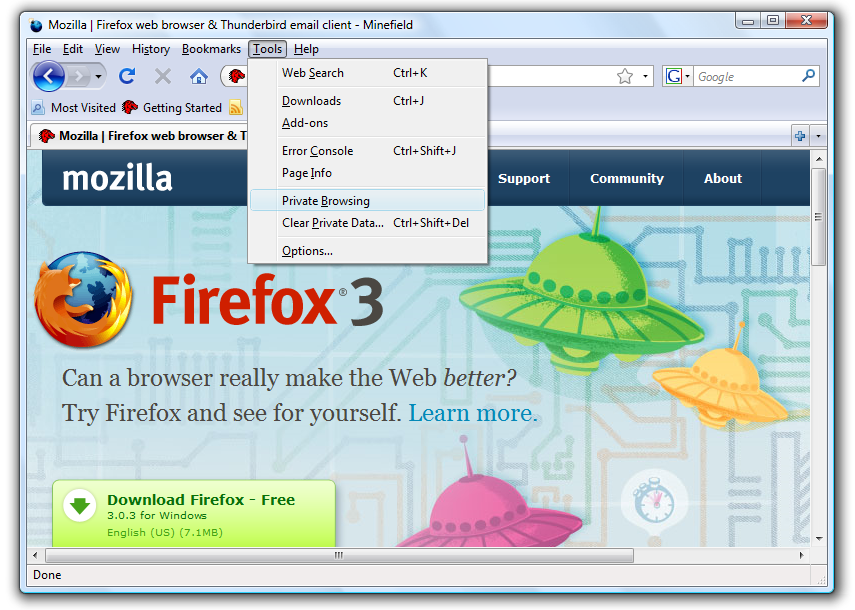
So how does one actually use this feature? It couldn't be simpler! To start, just select Private Browsing from the Tools menu.
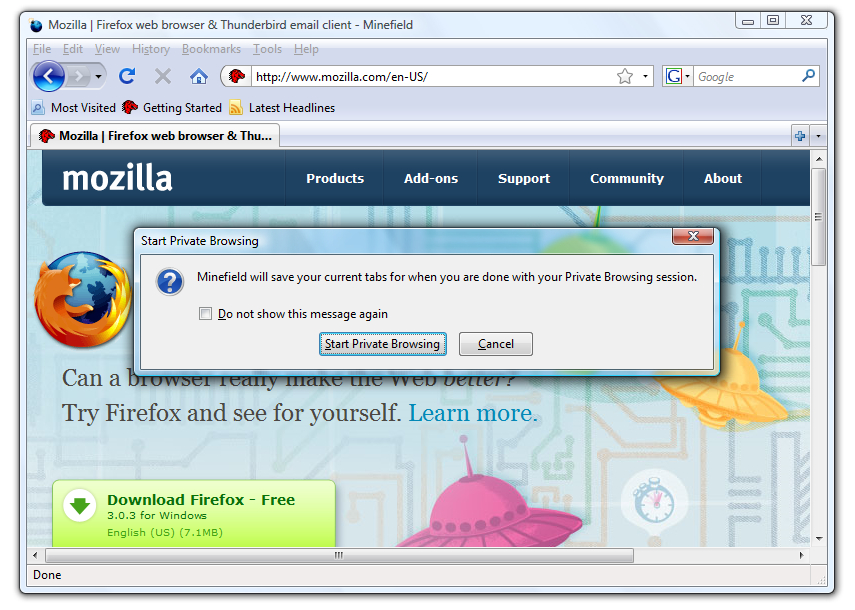
You will see a dialog box which asks you whether you want to save and close all of your current windows and tabs, and start the Private Browsing mode. Click Start Private Browsing to start your private session.
After you do this, your non-private browsing session is closed and a new private session is opened, showing you the screen below. (Before you mention, the ugly icon you see there is something I created as a placeholder! This icon will be replaced in the final release of Firefox 3.1.)
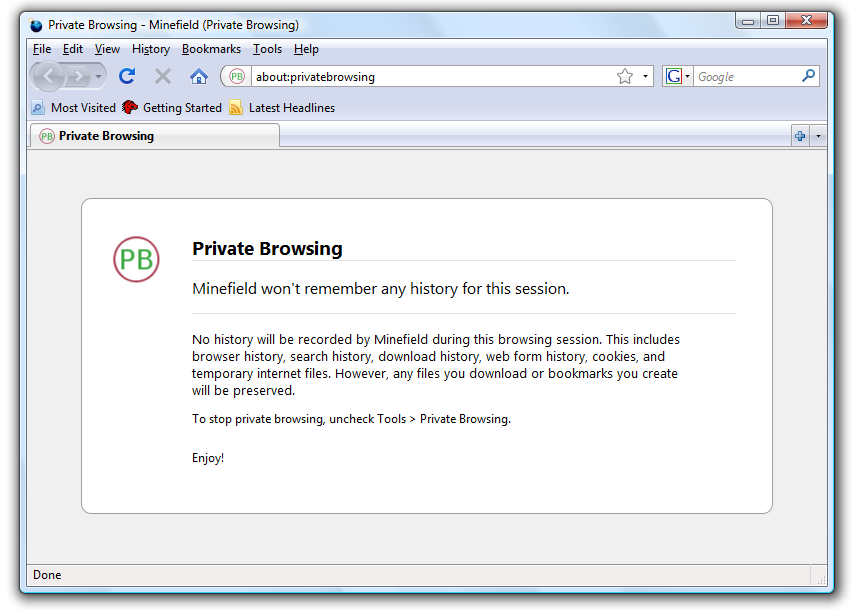
As you see, not much is different in the Firefox window inside the Private Browsing mode, except for the (Private Browsing) text added to the title bar at the top of the window. That is intentional: after all, if you're doing something online that you don't want your coworkers to know about, you don't want to raise their attention with a big sign saying PRIVATE as they pass by and glance over your shoulder. 
At this stage, you can start browsing web sites, without ever having to worry that Firefox might store something on your computer which can be used to tell which pages you have visited. Once you're done, just uncheck the same menu item in the Tools menu to close your private session.
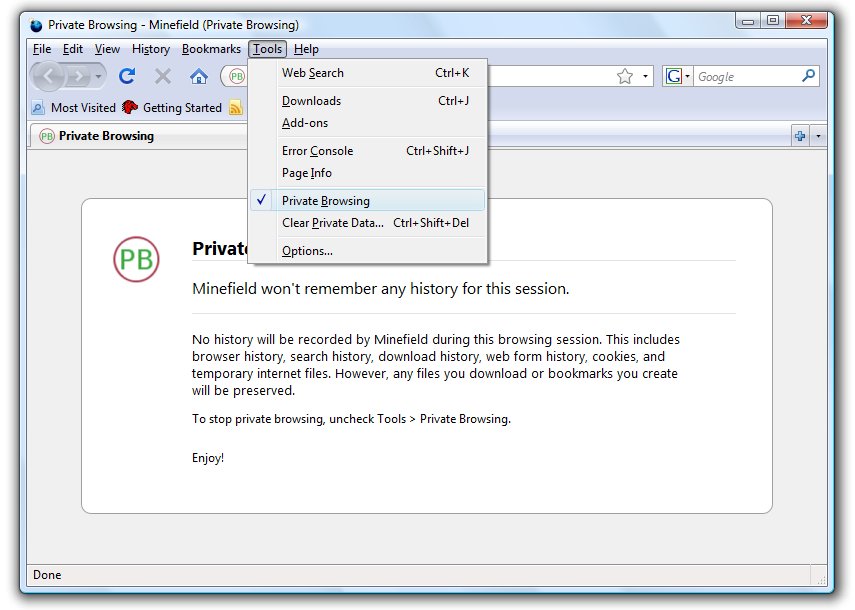
This action discards all of the data from your private session, and will restore your non-private browsing session, just like it was before entering the Private Browsing mode.
Now, as I mentioned at the top of this post, this feature is available in pre-release versions of Firefox 3.1 (what we geeks call nightly builds). This feature will be included in Firefox 3.1 Beta 2 which will be released soon, so if you want to try it, you can give it a shot then. And of course, it will appear in the final release of Firefox 3.1, so if you're not the type who test beta software, you can wait until Firefox 3.1 is released.
Update: As many people seem interested in knowing this, there is a way to make Firefox always start in Private Browsing mode. Go to the about:config page, click I'll be careful, I promise, type browser.privatebrowsing.autostart in the Filter text box, double click the entry to make its value true. After doing this, the next time you start Firefox, it will start in private browsing mode automatically. To turn this off, use the same steps to change the value of this preference to false. There is a plan to provide an easier method to set this option in the final release of Firefox 3.1.
Trackback URL for this post:
Mozilla firefox introduces private mode
from vijayjoshi.org on December 10, 2008 - 10:01Firefox users finally have the feature they were requesting for a long time. Pre-release of Firefox 3.1 Beta was done on 8th dec. This release includes, among many other features, an option to surf the web in Private mode.
This is similar to the Incogn...
firefox 3.1でプライバシーモード実装
from トランキの小部屋 on November 5, 2008 - 17:04先日google chromeのシークレットモードについてレポしましたが、firefoxの最新バージョン、3.1のベータ版で同様の機能を持つプライバシーモードが実...
Don't leave a trace: Private Browsing in Firefox
from Linux IT Consultant on November 5, 2008 - 05:15Today, a major feature was added to the pre-release versions of Firefox 3.1, called Private Browsing. I've been working for quite some time on this, so I thought it may be a good time to write about what this feature is and how to use it.
As you may ...


Comments
I have FF version 3.0
I have FF version 3.0 installed without this feature. All i can say, i just don't need it, because I can erase all the private date anytime I want with "clear private data".
Common opinion
nice post! Thanks.
Firefox is missing the boat here...
(Hey, first of all... great post... thanks for taking the time...)
I hate making statements like that (about FF missing the boat) - especially because Firefox when I found it somewhere closely after 2.0, was like heaven sent, a real gift to work with. IE for Mac was (thankfully) being written off by M$ and I tried convincing myself from day one that Safari when it came out was an IE killer when in fact Safari just sucks, it always has (in varying degrees) and chugging along at v.4 (b) isn't dramatically different except it's got the killer developer tools right at your finger tips AND coverflow for bookmarks so it looks like its doomed for inevitable suck-dom.
It'll be a couple years before there's really heated competition... on all levels, as a whole... but with Google Chrome's implementation of private browsing including the "multiple instances"-esque approach and this browsa called Stainless for Mac (a Chrome knock offwhich has had 100% success in the 6 months I've been testing it in effectively submitting masked User Agents - I feel bad for things like Opera that still battle it out one on one with individual websites despite their feature to change User Agent) with it's private browsing & tab specific cookies allowing multiple log ins under different credentials to the same site... I think Firefox made the best decision for the here and now but who knows how long before people smarten up and start to feel the FF implementation is a dumbed down version of PB'ing. And from reading the Mozilla PB wiki https://wiki.mozilla.org/PrivateBrowsing, it sounds like they put a lot of long hard work into it.
And I wonder how PBing will play out in enterprise... I don't know the distribution stats about FF in business, but the majority of Fortune 500 co's expressly forbid browsing that is not work related and usually block a bunch of domains known to suck up your day.
I am terribly thrilled though with the new tear away tabs! I often have my laptop hooked up to my flat screen and will browse for something to watch on it and then have to either drag the whole window which may have other tabs with it over to the TV only to drag it back when video is done or cut n paste url to new window on the TV.
(and a big thumbs down to geolocation - you tell SOMEBODY, ANYBODY who will listen that they have done more harm then good by releasing this pathethic information http://www.mozilla.com/en-US/firefox/geolocation/ which is pretty much standard FF disclosure and business as usual for any feature. It's pathetic because there's absolutely no end-user justification presented AT ALL. Just "talk to a third party about what they are going to do with your information." This isn't like having a cell phone and being lost in the woods and tracked down for rescue by helicopter. It's bad enough IP addresses get submited all over the place. But I'll find another blog to cry about this on.)
Partition Memory
I realize that the data from the browsing session will not be stored in the regular memory of my computer, but will files used by the browser be found in the partition memory if someone were to go looking there?
Re: Partition Memory
I'm not sure what you mean by "partition memory", but in private browsing mode, no personal information will be stored on any part of your hard disk.
No more "clear private data"
I hate it when people come to my house and do something and then click the click private data, they delete my information, now with the feature you described here it solves the problem. I will tell everyone who approaches my computer to wait a second will turn this feature on and will explain what it does and when they go I will disable it.
Thanks for that info
Hello, Will there be a button
Hello,
Will there be a button that I can add to the toolbar to enable/disable this feature more quickly than going into the tools menu? I'd like to see this feature.
Lee
Re: Hello, Will there be a button
Yes, such a button is already available using the Toggle Private Browsing extension which I have written about before.
Private Browsing- Mode Indicator Suggestion
There have been many intelligent suggestions on hiding the PB mode from peepig toms while at the same time reminding the user that he is in PB mode or otherwise.
I have a suggestion that may achieve both.
The user can select a thumbnail image from his /her image collection THAT would be his personal cutomized reminder that the user is in private browising mode without anyone suspecting it. ONLY THE USER KNOWS WHAT THAT ICOn / IMAGE MEANS.
This thumbnail can sit as an ICON in the address bar / side bar
Laternatively it can be a part of the web page at a fixed location so that it appears as just one of the images to anyone with passing curiosity.
Since I am not a software engineer, I cannot comment on the technical feasibility of this BUT it should be posssible to implement this.
User can frequently change this image. Obviously the image sgould be some kind of gawdy or eye-candy & not very dull if it to serve this purpose proper
Re: Private Browsing- Mode Indicator Suggestion
Thanks for your feedback!
I'm afraid that with your suggestion, the presence of the icon itself might be an indicator of the private browsing mode being active. That is, if someone passes by and notices an image in an unusual location, the fact that the image is there is enough for them to tell whether the private browsing mode is active or not.
Pingback
[...] habe keine Ahnung, was Du damit meinst. Das ist der neue Firfox Porno-Modus. Hat SM nach nicht. http://ehsanakhgari.org/blog/2008-11...owsing-firefox bye, Sascha -- "Oh Gott im Himmel, der du geschaffen hast die Berge, das Meer, das [...]
Private Browsing
My version of Mozilla is 3.0.8. I do not see the option of enabling private browsing under tools menu. Is it possible that teh administrator would have removed the tool while installation?
Re: Private Browsing
Private Browsing is a feature which will be part of Firefox 3.5, which will be released soon. To test the feature right now, you need to install a Beta version of Firefox.
Pingback
[...] menu. There is a hidden way to make Firefox 3.1 Beta 2 always start in Private Browsing Mode and a plan to possibly provide an easier way to do this in the final 3.5 release, but the only obvious use for [...]
Pingback
[...] приватного web-серфинга, когда никакая информация не оседает в кеше браузера, [...]
Will the IT departmetn know which sites I visit through PB?
Hi. I'll throw a question most of you will find a bit stupid. I'm not a techie so I'll just go ahead and shoot the question: Does going PB prevent the IT department from knowing which sites are you visiting?
Safe internet browsing
While PB does help, what you want is to use a proxy server while browsing the web.
Two options:
1. Type the proxy server IP and port into your web browser. (google free proxy servers for free public proxy IPs).
2. Use a proxy server client such as annonymizer.com
This method will allow you to surf all you like whilst using your work computer without the IT team knowing.
Chain proxy
You can also use chain proxy for more anonymity.
Re: Will the IT departmetn know which sites I visit through PB?
Yes, they can monitor your Internet activity if they choose to.
Basically, it's not truth. US
Basically, it's not truth. US government can somehow try t monitor us ISPs, but if you use satellite connection registered anonymously, they can't track you
One keystroke for frequently used phrases
Would it be possible to include in future versions of Mozilla a system whereby frequently used phrases can be added to the cursor by touching one or two keys eg contrl + 1 would give you your email address & contrl + 2 would give you your home address? This would save a lot of time for slow typists!
I have recently purchased 'Error fix' to sort out some problems with the slowness of my computer/ISP & after running it I find that Mozilla no longer stores my username/password. How can I fix this?
Re: One keystroke for frequently used phrases
About the key stroke feature, it would be best for you to file an enhancement request at Bugzilla. About the problem you're facing with the usernames and passwords, I suggest you ask your question on the support forum.
Private Browsing
LOL, I used to DELETE history in order to let other's dont know about my activity. I am using firefox since couple of year and upgrade each time when i find new upgrade but i didnt notice this feature (thanks for heads up!). However, as you mentioned, this features is only when PCs are shared with others. In my case, my PC is my very personal PC. So, i wouldnt need to use this feature anyway!
After upgrading to FF3, I Noticed one problem, It crashes many times in a day. Older versions had no such issues. Anyone experienced this?
Re: Private Browsing
If you used to delete your history to prevent others from knowing your activities, chances are that you will find the private browsing mode very useful. Any site you visit in this mode will not leave any trace on your computer, so you wouldn't have to delete your entire history in order to not let the others know about your activities.
About the crash you're mentioning, it is very likely that it's being caused by a plugin or an add-on. I suggest you visit this page in the Mozilla Support web site, or ask your question on the forum.
This is a dope option
I'm loving firefox! Hey Eshan what do you think of google's chrome and their incognito option? I was just wondering what you think I am sure you guys have tried it out? Let me know.
Seth
Owner of Vegas Blog
Re: This is a dope option
Google Chrome seems like a nice browser. I have used their incognito feature only to compare it to our Private Browsing implementation, and I have not used the browser otherwise extensively.
Too many cookie dialogues!
I have "prompt me" as my action for cookies. In private browsing mode this is incredibly annoying as I get a dialogue for every single cookie and I can't tell it to permanently ignore the site.
yeah, the same trouble with
yeah, the same trouble with the cookies
Re: Too many cookie dialogues!
This problem was filed as bug 468700 in Bugzilla, and has been fixed on "trunk" (which will be Firefox 3.2 Alpha 1), and is currently waiting to get approval to be fixed in Firefox 3.1 Beta 3.
Hotkeys
Nice work. Now all we need is a hotkey, like ctrl+shift+p or anything, and this is perfect. I dont believe that features used more than very seldom should be without hotkeys.
-WGZ
Re: Hotkeys
Thanks for your feedback! We have added hotkeys for entering and leaving the private browsing mode, which will be available in Firefox 3.1 Beta 3 (or currently in Shiretoko nightlies). And you would be pleased to know that we have used the same Ctrl+Shift+P combination that you have suggested!
Pingback
[...] en la edición 3.1 Beta 2, publicada hace unas semanas, el modo de navegación privada no es una herramienta para mantener el anonimato ante los propietarios de las páginas web que visitas o tu proveedor de acceso, sólo garantiza que [...]
Pingback
[...] en la edición 3.1 Beta 2, publicada hace unas semanas, el modo de navegación privada no es una herramienta para mantener el anonimato ante los propietarios de las páginas web que visitas o tu proveedor de acceso, sólo garantiza que [...]
Pingback
[...] en la edición 3.1 Beta 2, publicada hace unas semanas, el modo de navegación privada no es una herramienta para mantener el anonimato ante los propietarios de las páginas web que visitas o tu proveedor de acceso, sólo garantiza que [...]
Pingback
[...] en la edición 3.1 Beta 2, publicada hace unas semanas, el modo de navegación privada no es una herramienta para mantener el anonimato ante los propietarios de las páginas web que visitas o tu proveedor de acceso, sólo garantiza que [...]
Private tabs
I know that you have already answered that private mode Chrome-like (not closing non-private window) will require in-depth code changes...
So here you have another and more difficult one (I think).
If possible I would have 3 selectable private modes. The user would be able to select how he wants FF to work:
1st. Like FF 3.1. So FF swaps from private to normal.
2nd. Like Chrome. So FF opens a new private window, while original FF is kept normal.
3rd and more difficult. Private tabs mixed with normal tabs within the same window. When you select Private, a new private tab (marked somehow) would appear. From this tab you will browse in private mode. Any new tab opened from this page through Middle Click or whatever will stay in private mode. In this way you'd have a mixture of private and normal tabs in the same window. Also if possible, through Tools or Right click menu you should be able to change the Private/Normal state of any tab. When a tab is "privatized" it stops saving critical info.
Re: Private tabs
A challenge here (besides the required code changes) is how to deliver the information about the state of a tab to the user without being too subtle (and unnoticeable) and too obtrusive. Do you have any suggestions?
I can think about a few
I can think about a few options although it need to tested in real life:
+ Using a grey background (or other selectable colour) and/or special text format (as example blue font) in the Address bar.
+ With an extra icon (example your "(PB)" placeholder icon) in the address bar, next to the bookmark star, or at the beginning of the Address bar (before the web icon).
+ Outlining the tab with a dotted pattern (of selectable colour).
+ Changing the tab text font (grey colour, italics, underlined, just another font).
+ With your "(Private Browsing)" text in the window title.
+ Any other text (as example just "PB-") before the web name shown in the tab.
+ A text/icon in the status bar.
+ ...
But any of these markers, or any other possible ones, should be fully customizable. Maybe some people don't want to show any sign of being in PB mode, (using it at work, not wanting to get attention because someone says "Hey! this guy is in PB mode, let's see what he's looking at", ...), while other users will use it just as an added security/privacy option while shopping on-line from their homes, so they will want to ABSOLUTELY know and notice which tabs/windows are on PB mode and which ones aren't.
In addition to the tools menu switch, I would add another one on right-click menu. If the user decides to hide any external sign of being using PB browsing, these switches would be the only available signs, and because of their position, they would be normally hidden.
Re: I can think about a few
Among the solutions you suggested, those which deal with the window title, and the status bar won't be good ideas because these parts of the application are usually associated with the application, not the tabs. The solutions dealing with the address bar have a similar problem: the address bar is associated with the current page, not with other tabs (and users need to know whether a tab is in the private mode or not without having to actually switch to it). The best solutions I think are the ones dealing with the tabs themselves, but even they are not perfect: what if I'm working on a specific page, but its tab is not currently displayed? Or what if I hide tabs for single tabs in a window? What if I have an extension installed which changes the display of tabs (such as giving it a particular color, etc)?
Overall I think doing this will tend to confuse a lot of people, unless we have a clear way to distinguish private and non-private tabs. Note that the implementations such as Chrome's do this effectively by grouping tabs inside a window, which the user is already familiar with (i.e., if a tab is in Window A, then it's private, if it is in Window B, then it's not private).
I'd be happy to hear from you further on this issue. Thanks for taking the time to think about this!
Well, I think showing if you
Well, I think showing if you are in PB or not is not HUGELY critical as a general information. An unaware user, using PB without knowing it, will just lose History and Cookies...
Maybe an extra PB icon in the tab could be enough as the general basis in order to distinguish between PB and normal tabs for the 3rd PB mode. And also you could put an optional switch which would kept grouped PB tabs and normal tabs. In this way you could have private tabs at the beginning and normal tabs after them. If you open a new private tab, instead of going to the right most end, it would go to the right end of the PB group.
The other notifying options, (which are window related so they are only displayed for the current tab), just help the user about noticing if he is or not in PB (within that window/tab/session or whatever).
But as I already said, I think these marks should be fully customizable (whichever are implemented). Some users will want FF to SHOUT, (yes, in capital letters), at them that they are in PB mode, while others won't want any external sign of being in this mode.
(And speaking about obvious signs of being in PB: if possible you could also code a "Private Browsing" watermark overlaid in the main window content, like "Confidential" in spy film archives ;) )
Re: Well, I think showing if you
Firstly, being able to determine whether or not a tab is in private mode is very important, not because that you may think that a private tab is not private, but because the reverse could happen, i.e., you may think a tab is in private mode while it's not.
Also, I think that extension authors may be able to provide different kinds of UI for indicating the private browsing mode status (like for example a shouting UI!
), and I'm sure some extensions which do exactly this will pop up sooner or later.
But I think maybe we need to wait for the core code to support private browsing mode per tab instead of globally, and then we can come up with UI ideas.
Pingback
[...] preview release intended for developer testing and community feedback. New features include a private browsing mode, new functions that make it easy to remove specific portions of web history, a new javascript [...]
Pingback
[...] Don’t leave any tracks with private browsing mode [...]
I like how...
I like how chrome allows you to make an incognito mode window. That way you can have a window open for "private browsing" and the other for normal browsing. I also like how they make the browser window look different when you are in incognito mode. Cool that Firefox is getting this feature. I haven't ever used it in any of the browsers that I use, but I might someday. My web sites. burun estetiği thank you.
Pingback
[...] preview release intended for developer testing and community feedback. New features include a private browsing mode, new functions that make it easy to remove specific portions of web history, a new javascript [...]
The implementaion of this
The implementaion of this feature in Google Chrome is better, I mean why close the current non-private session? Just open a new windows with in private-mode, better no?
Or at least give an option, something like this:
1. End and Save the current session and start new private session.
2. Open new windows in private-mode.
3. Cancel.
The wording can be better, but just to clear my point.
Thank you guys for the good job on FF3.1!
Mike
Re: The implementaion of this
Thanks for your feedback. We also don't think that the current implementation is ideal, but what you describe requires major architectural changes which were simply not possible for the 3.1 release. Hopefully we would have a better implementation for a future release of Firefox.
I love this new feature.....
I love this new feature..... It saves me a lot of time cleaning up things...
One added feature would be when you leave the private mode, that it would list all files that were download (ex. PDF or image files) and not automatically removed (cleaned up)... I.e. if I download a file, that it would give me a log or a list so that I can clean those up as well...
Re: I love this new feature.....
The Download Manager, accessible from Tools | Downloads already does that. And there is a handy Clear List button if you want to delete the whole list in one go. Or you can select individual entries and click Delete.
Pingback
[...] Private Browsing Hi, neues Feature: Tools -> Private Browsing bzw. http://ehsanakhgari.org/blog/2008-11...owsing-firefox bye, Sascha -- "Oh Gott im Himmel, der du geschaffen hast die Berge, das Meer, das [...]
Post new comment